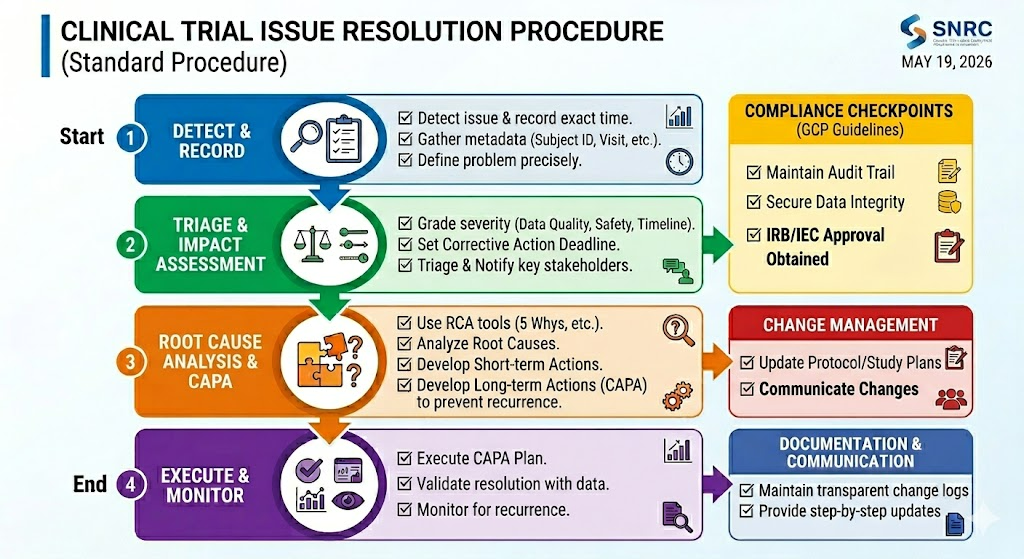
Unexpected issues during a clinical trial can be daunting. A single oversight can lead to timeline delays or, worse, compromise the integrity of your hard-earned data.
In this post, we share a practical protocol for clinical trial issue resolution. Learn how to systematically identify root causes, take swift action, and manage documentation without breaking a sweat. Read on to master everything from initial issue triage to long-term recurrence prevention!
🏃♂️ The 4-Step Issue Resolution Procedure
By following these four steps, you can tackle complex problems consistently while ensuring flawless documentation.
Step 1. Detect & Record
- Seize the Golden Time: Immediately log the exact time the issue occurred and determine its initial scope of impact.
- Gather Data: Collect all relevant metadata associated with the affected data points (e.g., subject ID, visit number).
- The One-Liner: Summarize the complex situation into a concise, easy-to-understand “Problem Statement.”
Step 2. Triage & Impact Assessment
- Grade the Severity: Assess how critically the issue impacts data quality, subject safety, and the overall trial timeline to determine its priority.
- Set Deadlines: Establish a clear timeline for corrective actions and immediately notify key stakeholders (CRAs, PMs, etc.).
Step 3. Root Cause Analysis & Action Plan (RCA & CAPA)
- Find the Root Cause: Use RCA tools or the “5 Whys” technique to dig past the symptoms and find the actual underlying problem.
- Two-Track Strategy: Develop immediate “Short-Term Actions” to contain the issue, alongside “Long-Term Actions (CAPA)” to prevent it from happening again.
- Define Success Metrics: Establish clear indicators to verify whether your solution actually worked.
Step 4. Execute & Monitor
- Verify the Data: Execute the solution and secure verification data to prove that operations have returned to normal.
- Preserve Records: Maintain transparent change logs and communication history.
- Ongoing Monitoring: Activate a follow-up monitoring plan to ensure the issue does not resurface.
🔍 Critical Compliance Checkpoints
Clinical trials begin and end with compliance. Here are 5 essential points you must verify when resolving any issue.
💡 The Clinical Trial Compliance Essential 5
- Documentation: Every decision and process change must be documented thoroughly with strict version control.
- Data Integrity: Secure data credibility by cross-verifying entries against the Source Original Data (SOD).
- Change Management: If an issue requires a change to the protocol or safety management plan, you must obtain IRB/IEC approval.
- Transparent Communication: Provide timely, step-by-step updates on the issue status to all primary stakeholders.
- Audit Trail: Leave an unedited digital footprint, including system logs, timestamps, and electronic signatures.
📊 Practical Application Matrix (Case-by-Case Summary)
Here is a quick-reference summary of how this protocol applies to three common scenarios on-site:
| Scenario | Issue Type | Resolution Summary | Compliance Point |
| Missing data due to a missed patient visit | ⚠️ Data Quality | 1) Detect ➡️ 2) Assess Impact ➡️ 3) Analyze Root Cause ➡️ 4) Execute Action | Verify SOD, generate discrepancy logs, evaluate need for IRB update |
| Protocol deviation discovered | 🚨 Compliance | 1) Report Immediately ➡️ 2) Assess Scope ➡️ 3) Prevent Recurrence ➡️ 4) Manage Change | Maintain change logs, follow strict IRB/regulatory authority reporting timelines |
| System error causing patient scheduling delays | ⚙️ Operational | 1) Map Communication ➡️ 2) Reschedule ➡️ 3) Re-validate Data ➡️ 4) Monitor | Secure communication logs, re-verify data endpoints |
💡 Pro-Tips & Best Practices from the Field
- Build Your Own Quick-Log Template: When an issue hits, panic can cloud your memory. Keep a simple, ready-to-use logging template on your desktop.
- Eliminate Communication “Ping-Pong”: Fast, transparent, and horizontal communication between teams can cut resolution time in half.
- Leave a Clear Paper Trail: Always document the rationale behind your decisions. Keeping a robust audit trail is your best defense during inspections and audits.
🎯 Conclusion & Call to Action (CTA)
Don’t just read about these steps—put them into practice today! You don’t have to overhaul your entire workflow at once. Start small by creating a simple “Issue Definition Template” or setting up a shared “Weekly Issue Log” spreadsheet for your team.
Before you log off today, ask yourself these four questions regarding your current project:
- ⬜ Have I defined the current issue clearly in a single sentence?
- ⬜ Are the impact scope and resolution deadline explicitly stated?
- ⬜ Did I use an RCA tool to find the root cause, rather than just patching the symptom?
- ⬜ Is there an escalation and cross-department collaboration plan in place if needed?
The speed and quality of your issue resolution directly define your trial’s competitiveness. Build your team’s checklist today and elevate your operational efficiency!
#ClinicalTrials #ClinicalResearch #CRAGuide #GCPCompliance #CAPA #DataIntegrity