In the fast-paced world of digital marketing and e-commerce, AI-driven CRO (Conversion Rate Optimization) tools have undeniably become one of the hottest trending topics.
Yet, when it comes to pulling the trigger and adopting one for your own product, it is easy to feel completely stuck. Questions like “Will this actually deliver a measurable return on investment?”, “How seamlessly will it plug into our current data stack?”, or “Are we risking algorithmic bias?” create severe decision paralysis, causing teams to delay implementation indefinitely.
If you are a growth leader struggling to gauge the real-world value of AI CRO tools, this guide is for you. We break down the cold, hard pros and cons of AI CRO, map out a practical blueprint to forecast your ROI, and give you an airtight tool selection framework to fast-track your decision-making. Let’s dive in! 👇
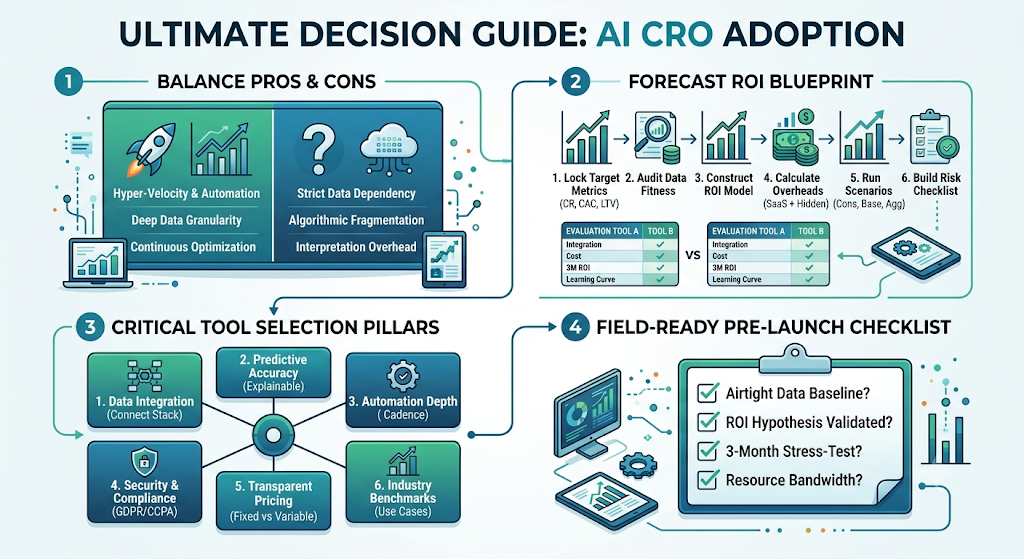
📊 1. At a Glance: The Pros & Cons of AI CRO
Before jumping onto the trend bandwagon, you must thoroughly understand both the superpower and the inherent boundaries of AI-driven optimization.
💡 The Superpowers (Pros)
- Hyper-Velocity & Automation: It executes repetitive multi-variable A/B tests in a fraction of the time it takes a human marketer, drastically compressing your optimization deployment cycles.
- Deep Data Granularity: It evaluates complex, multi-layered user behavioral events to map out subtle conversion paths and hidden drop-off patterns that human analysis easily overlooks.
- Continuous, Always-On Optimization: By minimizing subjective human bias, it serves up highly granular, real-time personalization suggestions tailored dynamically to live business scenarios.
⚠️ The Boundaries (Cons)
- Strict Data Dependency: The ‘Garbage In, Garbage Out’ rule applies heavily here. If your underlying tracking data is low-quality or plagued by missing server logs, the AI’s recommendations will quickly become unstable and unreliable.
- Algorithmic Fragmentation: Different software vendors utilize vastly diverse core algorithms and machine learning approaches, meaning the exact same dataset can yield widely differing outputs and performance expectations.
- Contextual Interpretation Overhead: AI solutions will give you the “what” but not necessarily the “why.” Your growth team will still face additional operational overhead to interpret the broader business context behind an AI suggestion before deploying it to production.
📈 2. The Step-by-Step Blueprint to Forecast Your ROI
To build a reliable growth narrative for AI CRO, you must move past gut feelings and simulate value using strict data projections.
- Step 1 [Lock in Target Metrics]: Explicitly define the primary baseline KPIs you aim to move—whether it’s raw conversion rate (CR), Customer Acquisition Cost (CAC), or Customer Lifetime Value (LTV).
- Step 2 [Audit Your Data Fitness]: Evaluate your current analytics setup for tracking leaks, sampling biases, and data disparities across tracking domains.
- Step 3 [Construct the ROI Model]: Predict net returns using the core equation:ROI=(Expected Conversion Lift×Average Revenue)−Implementation Costs For example, if you model a 15% lift in conversion with an Average Order Value (AOV) of $50, calculate the net quarterly revenue expansion.
- Step 4 [Calculate Hidden Overheads]: Look beyond the basic SaaS subscription price tag. Ensure you account for initial integration engineering costs, internal onboarding hours, and ongoing staff training resources.
- Step 5 [Run Multi-Scenario Projections]: Map out a multi-tiered forecasting matrix comparing Conservative, Baseline, and Aggressive conversion scenarios to stress-test your margins.
- Step 6 [Build a Risk Prevention Checklist]: Establish a dedicated monitoring framework to track data quality dips, software dependencies, and internal operator friction.
💡 [AI CRO Tool Comparison Matrix] Analyze the trade-offs between data integration, operational speed, and cost to find the perfect fit for your growth team.
| Evaluation Element | 🛠️ AI CRO Tool A | 🚀 AI CRO Tool B |
|---|---|---|
| Data Connectivity | High | Medium |
| Optimization Velocity | Fast | Moderate |
| Implementation Cost (Monthly) | $299 | $799 |
| Projected ROI (Initial 3 Months) | Moderate | High |
| Learning Curve | Low | Moderate |
🎯 3. Six Critical Pillars for Tool Selection
The long-term efficiency of your marketing budget depends entirely on how well a tool integrates into your daily workflows. Put candidate software proposals under the microscope using these six evaluation points:
- Data Connectivity & Stack Integration: Can it seamlessly plug-and-play with your existing product analytics tools, CRM software, and data warehouses?
- Predictive Accuracy & Explainability: Does the platform provide clear, transparent rationales behind its optimization recommendations so marketers can understand and defend the strategy?
- Testing Cadence & Automation Depth: How frequently can it run automated test iterations, and can it deploy winning variations directly to production without manual engineering tickets?
- Security, Privacy & Compliance: Does the tool’s data processing pipeline strictly adhere to modern data privacy frameworks (like GDPR/CCPA) and your internal corporate security protocols?
- Transparency of Pricing Structures: Is it a fixed subscription model or a variable fee based on traffic/revenue scales? Weigh these structures against the level of technical vendor support provided.
- Industry Benchmarks & Customer Success: Does the vendor provide verified, peer-reviewed use cases within your specific business vertical, alongside robust training materials?
🔍 4. Real-World Decision Frameworks
- 📱 Case Study A [Mid-Sized E-Commerce Platform]
- Objective: Drive the store’s baseline checkout conversion rate from 12% up to 15%.
- The Decision: Because their historical event-tracking logs were clean and high-velocity automation was their top priority, they selected Tool A due to its incredibly low learning curve and high price-to-performance ratio.
- 🗄️ Case Study B [B2B SaaS Subscription Model]
- Objective: Slash overall Customer Acquisition Cost (CAC) by 20%.
- The Decision: Given that their user subscription funnel was highly complex and required deep, multi-layered causal interpretation, they strategically chose Tool B to leverage its advanced predictive analytics features and superior long-term ROI potential.
📋 The Field-Ready AI CRO Pre-Launch Checklist
Before you authorize a subscription payment, review these four fundamental questions with your growth and product squads:
- [ ] Airtight Data Baseline: Are our current analytics tracking codes, server-side events, and user logs clean, validated, and fully reliable?
- [ ] Hypothesis & Metric Validation: Have we locked in explicit target KPIs and mapped out a structured financial projection for our expected ROI?
- [ ] 3-Month Margin Stress-Testing: Have we stress-tested a conservative 90-day simulation to guarantee the tool’s performance will offset its total implementation cost?
- [ ] Resource & Training Bandwidth: Does our growth team have the operational bandwidth to adopt this software, and is the vendor’s enterprise support system clearly defined?
🚀 Shifting to Execution: Your Next Steps (CTA)
At the end of the day, a successful AI CRO rollout relies on two non-negotiable factors: absolute data hygiene and realistic ROI simulation. Adopting complex optimization software purely based on market hype without evaluating these fundamentals is a fast track to draining your marketing budget.
Take action this week. Run a quick health check on your current data stack and align your team’s core growth objectives. Narrow your options down to 2 or 3 potential software solutions and map out your multi-tiered ROI matrices.
🎁 Struggling to build an accurate ROI projection model or unsure which tool fits your specific marketing tech stack? Drop a comment or submit an inquiry below right now! We will connect you with customized platform recommendations and open up [Exclusive Free-Trial Access & Personalized Expert Consultations] to eliminate downstream risks and fast-track your growth operations. Let’s build a smarter, automated conversion engine together! 🚀
#DecisionMaking #ROI #ToolSelection #GrowthGuide #DigitalMarketing #AI_CRO #ConversionRateOptimization #MarketingAutomation