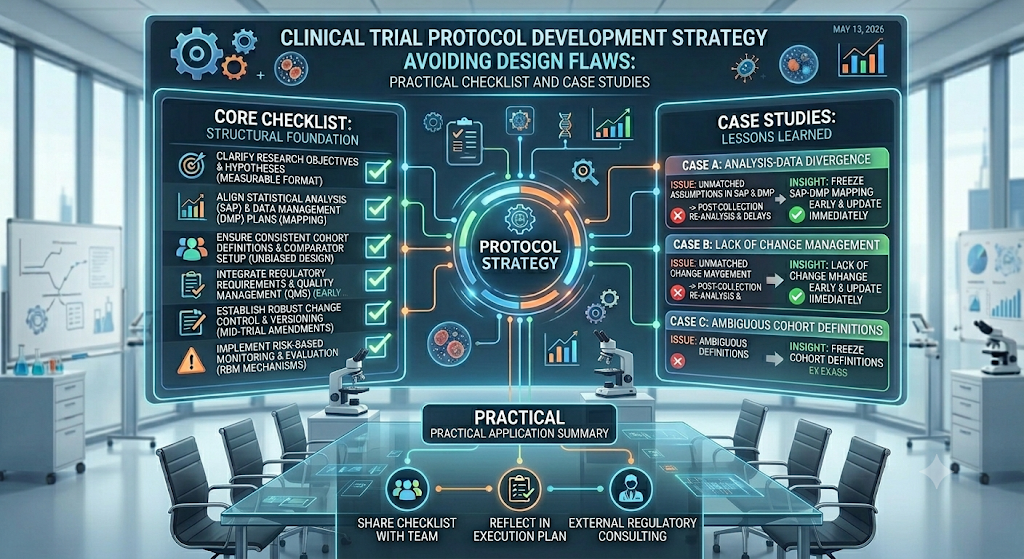
As the foundational backbone and compass of any clinical trial, the Protocol serves as a vital bridge connecting ultimate research objectives with complex regulatory requirements.
However, even the most seasoned clinical practitioners can commit critical mistakes during the early design phase, such as setting ambiguous objectives, failing to perfectly align statistical analysis plans with data management workflows, or completely omitting change control mechanisms. These minor oversight gaps inevitably snowball into “regulatory approval delays” and “exponential budget inflation.”
In this post, we will look at this from a hands-on operational perspective to break down a “Core Checklist” that dramatically mitigates design flaws and elevates protocol quality, alongside key takeaways derived from “Real-World Case Studies.”
📋 The Structural Backbone of Protocol Design: Core Checklist
Before finalizing your clinical trial protocol draft, ensure your team evaluates these non-negotiable structural elements:
- [ ] Clarification of Research Objectives & Hypotheses: Are the primary hypotheses articulated in a strictly measurable format?
- [ ] Consistency in Cohort & Comparator Setup: Are the subject population definitions, randomization methodologies, and control group parameters designed without bias?
- [ ] Bidirectional Alignment of SAP and DMP: Do the Statistical Analysis Plan (SAP) and Data Management Plan (DMP) map to one another perfectly without conflicting assumptions?
- [ ] Integration of Regulatory Requirements & QMS: Are the target agency’s mandates and Quality Management System (QMS) oversight fully embedded from day one?
- [ ] Solidification of Change Control & Versioning: Is there a robust version-tracking system to handle inevitable mid-trial protocol amendments?
- [ ] Risk-Based Monitoring & Evaluation Mechanisms: Are Risk-Based Monitoring (RBM) and systematic risk assessment frameworks operational within the design?
- [ ] Standardization of Mandatory Documentation: Are crucial Standard Operating Procedures (SOPs), templates, and official documentation standards explicitly established?
📊 At-a-Glance Checklist Execution Blueprint
The matrix below summarizes the exact operational points to verify for each focus area and their expected strategic outcomes:
| Focus Point | Field Verification Point | Expected Strategic Outcome |
| Objectives & Hypotheses | Verifying measurability of hypotheses and explicit termination/end-of-study criteria | Ensures absolute consistency in data interpretation and structural direction |
| Study Arms & Cohorts | Sample size justification, randomization schemes, and definitive control groups | Minimizes potential bias (Bias Control) and secures robust statistical power |
| SAP / DMP Alignment | 1:1 cross-mapping between data analysis scenarios and data management procedures | Strengthens compliance linkages between regulatory requirements and actual analysis |
| Change Control | Formal logging of amendment rationales and clear thresholds for ethics committee re-evaluation | Controls operational and financial risks triggered by sudden protocol adjustments |
| Documentation | Strict version number formatting, authorized signatory logs, and audit trail maintenance | Maximizes evidentiary credibility during rigorous regulatory review processes |
💡 Case Studies: Practical Lessons from Protocol Design Flaws
Analyze these three common field vulnerabilities to discover how early strategic adjustments safeguard your clinical trial timeline:
❌ Case A: Divergence Between the Analysis Plan and Data Capture
- The Problem: The underlying assumptions in the SAP and DMP were developed in silos. Consequently, after the clinical data was fully collected, the biostatistics team had to re-execute data processing from scratch, causing severe project delays.
- 💡 Strategic Takeaway: Sponsors must freeze the formal SAP-DMP data mapping structure at the earliest protocol drafting stage and ensure immediate synchronization if any mid-study changes occur.
❌ Case B: Elevated Regulatory Risks Due to Absent Change Management
- The Problem: Critical operational modifications were implemented at clinical sites without being properly documented via official protocol amendments. During the regulatory agency’s inspection, the team wasted vast amounts of time and budget attempting to defend and justify the unlogged variations.
- 💡 Strategic Takeaway: A comprehensive change management workflow and a formal, tiered approval framework must be integrated into the protocol architecture prior to launching the study.
❌ Case C: Ambiguity in Patient Population Boundaries
- The Problem: The inclusion and exclusion criteria were framed vaguely. This ambiguity led to the screening of non-eligible participants, which resulted in massive protocol deviations, high screen-failure expenditures, and unexpected costs to track down and clean data.
- 💡 Strategic Takeaway: Patient eligibility criteria must be defined with absolute, mathematical precision at the very forefront of the trial design phase to leave no room for investigator misinterpretation.
🎯 Operational Next Steps: Action Guide for Your Team
An optimized clinical trial protocol development strategy is more than a regulatory requirement—it is a powerful tool to minimize iterative design costs. Execute these steps with your study team immediately:
- Conduct a Checklist-Driven Protocol Review: Download or duplicate this checklist and use it as the mandatory framework for your next cross-functional protocol draft review meeting.
- Assign R&R and Deadlines: Define clear ownership (R&R) and strict timelines for each unverified checklist parameter, and bind this action item matrix directly to your initial protocol version tracker.
- Accelerate Quality Metrics: If internal alignment remains uncertain, leverage this checklist to host a focused internal workshop or engage external regulatory consulting specialists to fortify both data quality and compliance.
💬 Share Your Protocol Design Roadblocks!
What is the most challenging bottleneck your team faces when drafting a clinical trial protocol? Whether it is aligning your SAP-DMP workflows or navigating strict regulatory feedback on inclusion criteria, feel free to share your field experiences or questions in the comments below!
- Date: May 13, 2026
- Tags: #DesignFlawPrevention #Checklist #CaseStudies #ClinicalTrials #RegulatoryRequirements #RiskManagement