Hello everyone! Anyone involved in clinical trials knows that unexpected issues often lead to a triple whammy: timeline delays, budget overruns, and compromised data quality.
In these critical moments, choosing the right Vendor Solution is the ultimate game-changer. However, navigating through a sea of available options can be overwhelming.
Today, we will break down a Vendor Solution Portfolio tailored for clinical trial issue resolution, complete with key comparison points and essential contract management tips to help you make an airtight decision!
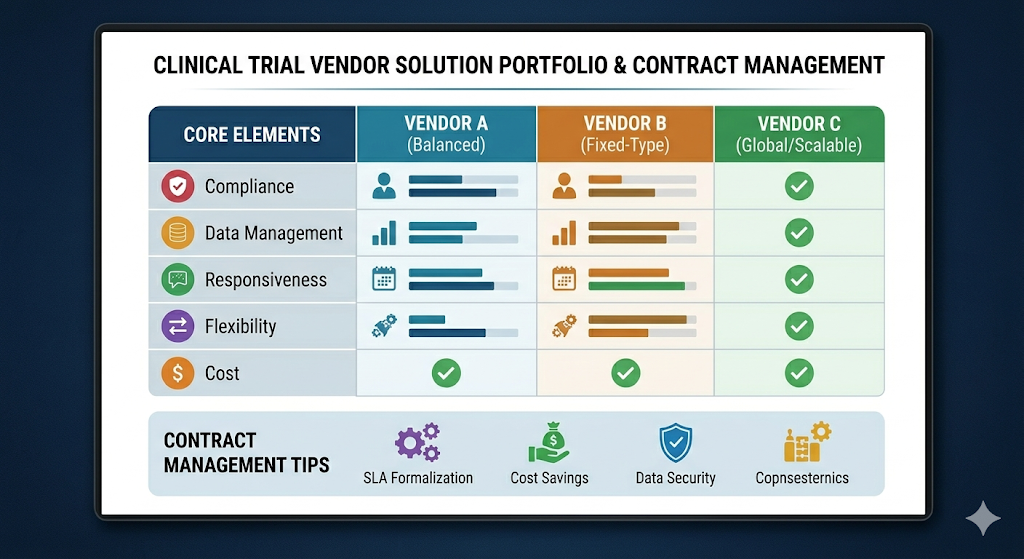
📌 Vendor Solution Portfolio: 5 Core Elements to Check
When evaluating vendors for your clinical trial, ensure they meet these five non-negotiable criteria:
- Compliance & Quality: Do they strictly adhere to international guidelines (e.g., ICH-GCP) and local regulations?
- Data Management Standardization: Do they guarantee data traceability, standardization, and robust audit trails?
- Responsiveness & Issue Resolution: Do they have a real-time alert system and an effective recurrence prevention loop?
- Contract Flexibility: Is there a clear, scalable framework for change orders and Service Level Agreements (SLAs)?
- Cost Structure Transparency: Are upfront costs, unit prices, and maintenance fees transparent and predictable?
📊 Vendor Solution Comparison at a Glance (A vs. B vs. C)
Which vendor fits your specific project needs? Here is a breakdown of three typical vendor solution models.
| Comparison Metrics | Vendor Solution A (Balanced) | Vendor Solution B (Fixed-Type) | Vendor Solution C (Global/Scalable) |
| Compliance | Good; well-documented | Average; potential for minor gaps | Excellent; updates to global regulations |
| Data Management | Strong in standardization | Presence of non-standardized areas | Outstanding data quality control |
| Responsiveness | Within 48 hours on average | Around 72 hours | Priority response within 24 hours |
| Contract Flexibility | Adjustable when necessary | Mostly fixed contracts | High scalability with flexible SLAs |
| Total Cost Structure | Low upfront cost, average maintenance | High maintenance; hard to predict | Highly predictable subscription model |
🔍 Real-World Case Studies
Case Study 1 (Multi-Center Clinical Trial):
A team adopted Solution A to leverage its robust alert system and recurrence prevention loop. As a result, data quality issues decreased by 30%, and the average time to resolution was significantly shortened.
Case Study 2 (Global Clinical Trial):
An organization chose Solution C for its exceptional global compliance and scalable SLAs, effectively mitigating contract risks. Furthermore, the subscription-based model allowed them to manage and predict their budget with high stability.
🛠️ Contract Management Tips & Cost Efficiency Guide for Professionals
No matter how excellent a solution is on paper, a poorly written contract can turn it into a liability. Review these 5 critical checkpoints before signing on the dotted line:
1. Formalize Concrete SLAs (Service Level Agreements)
- Avoid vague terms like “prompt response.” Explicitly define metrics in writing—such as Response Time, Resolution Time, and the exact Scope of Responsibility.
2. Establish a Transparent Change Order Process
- Clinical trial scopes frequently shift. Establish a pre-agreed methodology for calculating how changes in scope will impact the budget and timeline.
3. Set Regular Vendor Evaluation Cycles
- Re-evaluate Key Performance Indicators (KPIs) on a quarterly basis. Regular feedback loops keep vendors accountable and aligned with your goals.
4. Identify Cost-Saving Opportunities
- Carefully compare
License-based vs. Subscription-basedmodels. Don’t forget to check for regional tier pricing and whether maintenance fees are included.
5. Ensure Solid Data Security & Backup Plans
- Verify that data encryption standards, backup frequencies, and Disaster Recovery Plans (DRP) are explicitly and clearly documented.
🎬 Conclusion: Take Action Today!
Successfully resolving issues in a clinical trial goes beyond simply comparing product features—it relies heavily on systematic contract management and a strategic portfolio approach. Identify the biggest risk factors in your current study and choose the vendor best equipped to mitigate them.
Put this into practice!
Use the comparison matrix and tips above to build your own “Vendor Solution Checklist.” If designing the optimal mix for your specific protocol feels challenging, we highly recommend consulting with a professional advisor to save both time and budget.
We hope this guide helps streamline your clinical trial operations! If you have any questions or insights to share, feel free to leave a comment or reach out. 😉