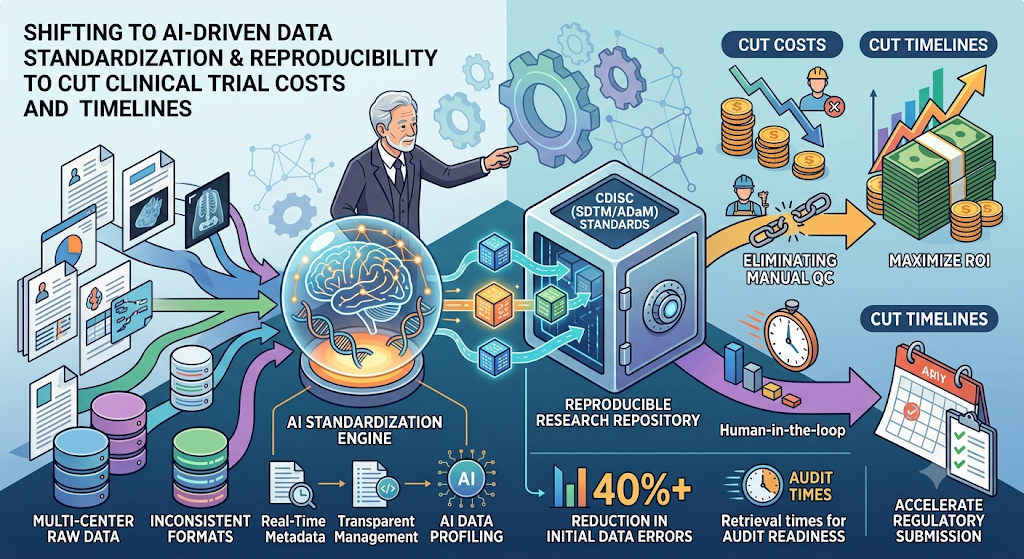
1. AI Innovation in Data Standardization (SDTM/ADaM): “Eliminating Manual QC”
Converting data into CDISC (SDTM/ADaM) standards for global regulatory submissions (FDA, EMA, MFDS) is historically a massive bottleneck. AI completely reimagines this workflow:
- Automated Data Mapping (Accelerating Time-to-Market): AI automatically maps disparate data schemas from various clinical sites into standardized SDTM-compliant formats. This completely bypasses human error and dramatically increases processing speed.
- Global Medical Terminology Standardization: Leveraging Natural Language Processing (NLP), AI automatically classifies inconsistent medical terms from the field into standardized global code systems like SNOMED and LOINC.
- Real-Time Automated QC: AI instantly detects data omissions, duplications, and inconsistencies, offering immediate corrective suggestions. This shrinks the traditional data cleaning phase from several weeks down to just a few days.
- Transparent Metadata Management: AI maintains a robust audit trail from the data’s point of origin through every single modification, drastically reducing regulatory inspection risks.
📊 Practical Business Impact: AI Implementation ROI
| Key Focus Area | Realized Value for Sponsors (ROI) | Risk Management Tip (Sponsor’s Corner) |
| Automated Data Mapping | Doubles data integration speed, slashing labor costs. | Establish a process to regularly check for the latest CDISC version updates. |
| Medical Terminology Standardization | Boosts statistical analysis credibility; minimizes regulatory rejection risks. | Set up a routine schedule to update external medical dictionary databases. |
| Automated Quality Control | Lowers overall data cleaning expenses; achieves early reproducibility. | Implement periodic human cross-checks to audit AI detection rules. |
| Metadata Management | Minimizes turnaround times for regulatory audits. | Enhance cybersecurity and access control frameworks for metadata. |
2. Winning Over Regulatory Agencies with an ‘AI-Driven Reproducibility Pipeline’
Regulatory authorities are scrutinizing the ‘reproducibility’ of submitted clinical data more rigorously than ever. If a change in the analysis environment yields different results, approval is off the table. Sponsors must use AI pipelines to quantify and present the robustness of their data.
- AI Data Profiling: AI pre-screens data distribution and anomaly patterns to proactively neutralize potential outliers or biases that could warp final statistical conclusions.
- Automated Pipeline Version Control: By version-controlling the entire journey from data extraction (ETL) to final statistical analysis, Sponsors can re-run the exact same analysis under any environment with a single click.
- Reproducibility Stress Testing: During the pilot phase, AI simulates how minor variations in input data affect final outcomes. This proves the robustness of the analysis to stakeholders and accelerates internal decision-making.
💡 Sponsor Success Case: Multi-Center Data Integration & Audit Readiness
A clinical team previously spent hundreds of thousands of dollars and over three months resolving data inconsistencies across more than 10 sites. By piloting an AI-driven standardization pipeline, initial data error detection improved by over 40%. Furthermore, data retrieval times for external audits were significantly reduced, allowing the company to secure its next IR funding round right on schedule.
3. A Sponsor’s Practical Guide to AI Quality Control
AI is a powerful accelerator, but it is not a magic wand. A Sponsor’s clinical operations team must keep three critical risk management practices in place:
- Monitor Data Bias & Omissions: Ensure rigorous validation protocols are active so that AI models do not introduce statistical bias or inadvertently misrepresent specific patient cohorts.
- Security & Privacy (Anonymization): Verify that the AI operates within a strict de-identification architecture to fully comply with global privacy laws (such as GDPR or local data protection acts).
- Human-in-the-Loop Framework: Clearly define the role of Data Managers (DM) as the ultimate authorities who review, consult on, and sign off on AI-generated mapping suggestions.
🎯 Conclusion: Protect Your Runway with an AI Data Strategy
Data standardization and reproducibility are not just IT checkboxes—they are vital business strategies that maximize License-Out (L/O) valuations and fast-track regulatory clearance.
You do not need to overhaul your entire infrastructure overnight. Start with a small pilot project to validate the ROI for your specific pipeline.
🛠️ 3 Immediate Action Steps for Sponsors
- Phase 1 (Diagnostic): Evaluate the current manual workload, timelines, and costs your CRO or internal data management team dedicates to standardization.
- Phase 2 (Targeting): Identify your most severe bottleneck—whether it is multi-center data integration or SDTM conversion—and prioritize it for AI integration.
- Phase 3 (Pilot): Run a proof-of-concept using historical clinical data or a small sample dataset to evaluate the accuracy and speed of an AI standardization solution.
Tags: #ClinicalTrials #DataStandardization #Reproducibility #QualityControl #AI #SponsorStrategy