In clinical trials, a single design error can drastically alter the interpretation of your results. This guide systematically identifies common pitfalls and provides essential principles and checklists—from initial design to data interpretation—to help beginners and professionals alike reduce research risks.
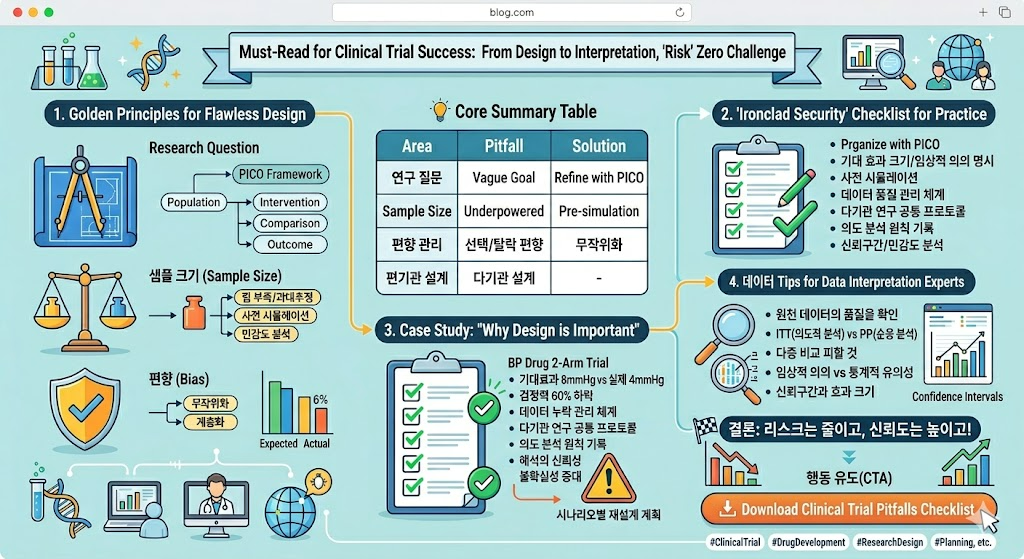
1. Problem Definition and Design Principles
The foundation of a successful trial lies in clarity. Ambiguity at the start leads to statistical misalignment later.
- Define Research Questions Clearly: Vague goals lead to inconsistencies between sample sizes and analysis methods.
- Utilize the PICO Framework: Specify the Population, Intervention, Comparison, and Outcome to solidify your requirements.
- Reflect Quality Management in Design: Address bias and data quality early through randomization, stratification, and proactive missing data management.
💡 Key Summary Table
| Area | Common Pitfalls | Solutions |
| Research Question | Vague or ambiguous goals | Solidify using the PICO framework |
| Sample Size | Underpowered or overestimation | Conduct pre-simulations and sensitivity analysis |
| Bias Management | Selection or attrition bias | Use randomization, multi-center designs, and pre-established analysis plans |
2. Practical Checklist for Implementation
Use this checklist to ensure your trial is robust before you begin data collection:
- [ ] Is the research question organized via PICO with clinical significance clearly stated?
- [ ] Have pre-simulations for sample size and analysis plans been conducted?
- [ ] Is there a data quality management system to handle missing data predictably?
- [ ] For multi-center studies, is there a common protocol and central data management plan?
- [ ] Are the analysis plans and Intent-to-Treat (ITT) principles recorded in advance to prevent bias?
- [ ] Does the interpretation plan include confidence intervals and sensitivity analysis to show uncertainty?
3. Understanding Through Case Studies
Theoretical principles are best understood through real-world scenarios.
Case: 2-Arm Clinical Trial for Blood Pressure Improvement
In a double-blind trial, researchers expected an effect size of 8 mmHg to calculate their sample size. However, the actual difference was only 4 mmHg, causing the statistical power to drop to 60%. Combined with an increase in missing data, the final interpretation faced significant uncertainty.
The Lesson: If sensitivity analysis and scenario-based redesign plans had been prepared in advance, the researchers could have made faster decisions regarding trial termination or redesign, ultimately increasing the reliability of their findings.
4. Practical Tips for Data Interpretation
Once the data is in, use these tips to ensure your interpretation is sound:
- Verify Raw Data First: Check the quality of source data and identify patterns in missing data to evaluate their impact on the analysis.
- ITT vs. PP Analysis: Clearly distinguish between Intent-to-Treat and Per-Protocol analysis, interpreting them according to the specific context of the study.
- Avoid Multiple Comparisons: Avoid unplanned multiple comparisons; if necessary, use pre-planned correction methods.
- Clinical vs. Statistical Significance: Always distinguish between statistical significance (p-values) and the actual clinical meaningfulness of the results.
- Provide Context: Present confidence intervals alongside effect sizes to offer a full context for interpretation.
🏁 Conclusion & Call to Action (CTA)
Key Summary: Avoiding clinical trial pitfalls starts with clear design, rigorous sample size and bias management, high data quality, and transparent interpretation. By applying these checklists at every stage, you can minimize risk and obtain highly credible results.
Tags: #ClinicalTrials #ResearchDesign #DataInterpretation #PICO #MedicalResearch #Checklist