In modern clinical trials, data quality and analysis speed have become core indicators of success. Traditional manual processes often lead to human errors, significant monitoring costs, and schedule delays.
Today, we will summarize the specific benefits and practical application points of adopting AI in clinical trials from a researcher’s perspective.
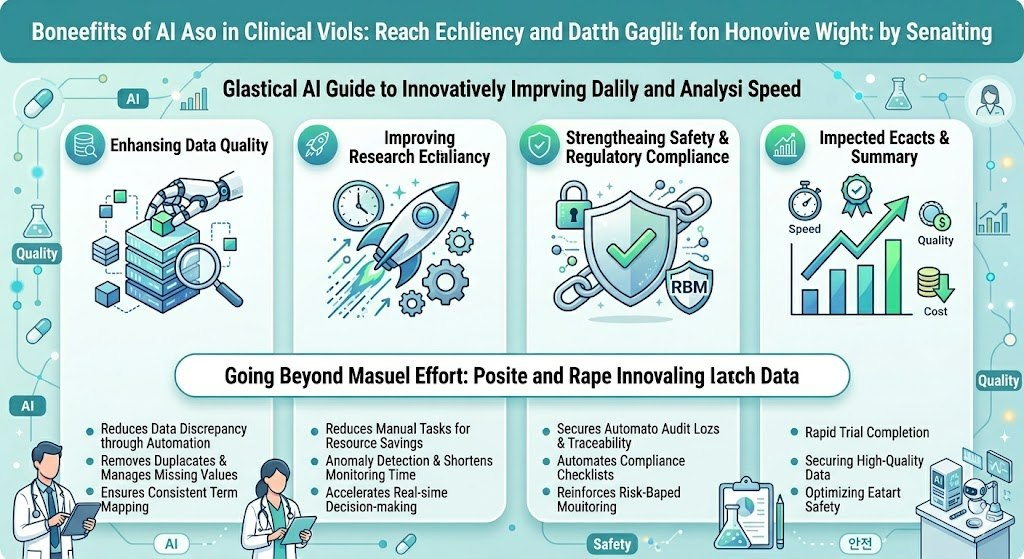
💡 Why AI is a ‘Game Changer’ in Clinical Trials
Using AI in clinical trials does more than just speed up the process. It elevates the reliability of data, allowing researchers to focus more on essential analysis.
1. Significant Improvement in Data Quality
- Automated Standardization: Minimizes discrepancies in source data through OCR (Optical Character Recognition) and NLP (Natural Language Processing).
- Enhanced Precision: Increases analysis reliability by removing duplicate data and managing missing values.
- Consistency: Ensures consistency in term mapping and data transformation by reducing subjective human intervention.
2. Maximizing Research Efficiency
- Resource Reduction: Dramatically reduces repetitive manual tasks with automated data coding and validation systems.
- Proactive Response: Anomaly detection algorithms predict risks, shortening monitoring time.
- Rapid Decision-Making: Allows for immediate adjustment of research direction through real-time data dashboards.
3. Enhanced Safety and Compliance
- Transparent Auditing: Secures perfect traceability through automated Audit Trail generation.
- Risk-Based Monitoring (RBM): Bolsters patient safety by detecting abnormal signs in subjects in real-time.
📊 Summary of AI Application Cases & Expected Effects
Compare how AI is used in the field at a glance.
| Application Area | Specific Case | Expected Effect |
| Data Management | Source data extraction based on OCR/NLP | Improved data quality, processing speed increased by 2x+ |
| Data Coding | Auto term mapping & standard code assignment | Improved data reproducibility, easier response to external audits |
| Monitoring | ML-based anomaly detection & alerts | Enhanced patient safety, reduced time for follow-up actions |
🛠️ Implementation Guide: How to Get Started?
If adopting a large-scale system feels overwhelming, we recommend a ‘Small Start’ strategy.
- Identify Bottlenecks: First, find the 1 or 2 stages in the data flow where delays are most severe (e.g., data entry, coding).
- Pilot Adoption: Select 1 or 2 proven AI tools and apply them to a small-scale project first.
- Set & Measure KPIs: Compare before and after adoption using metrics such as reduced data missing rates, shortened analysis time, and anomaly discovery rates.
🚀 Conclusion: The Future of Research is Now a Necessity
Using AI in clinical trials is no longer just a trend; it is a vital strategy for research competitiveness. If you want to improve data quality while shortening research periods, plan an AI pilot project today.
Any questions?
If you need a comparison of AI tools suitable for your lab or expert consultation, please leave an inquiry at any time. We will join you on your journey to elevate the quality of your research.