In the healthcare and clinical environment, risk management is an absolute core priority that dictates both patient safety and operational excellence. Risks are often invisible during daily operations; however, without a proactive prevention and management ecosystem, they inevitably spiral into recurring errors and massive institutional losses.
“Where exactly should we begin our risk management journey?” Today, we break down a plug-and-play ‘5-Step Identification-Evaluation-Response Framework’ , dissect real-world failure case studies , and provide a comprehensive regulatory compliance checklist to optimize your clinical workflows immediately! 👇
🎯 1. The 5-Step Practical Flow of Risk Identification & Evaluation
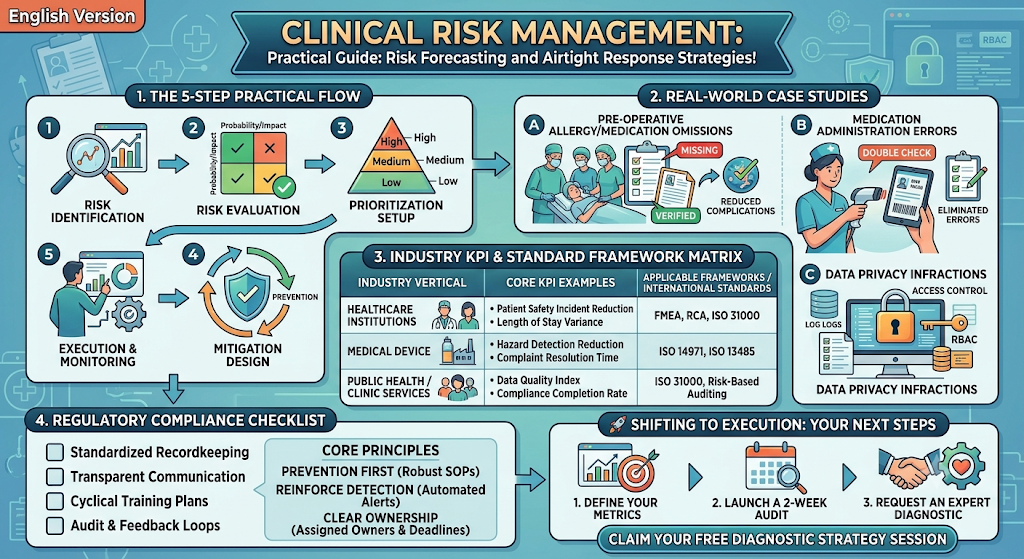
Mitigating predictable risks beforehand can prevent numerous medical errors and eliminate budget inefficiencies. Keep this 5-step risk management workflow locked into your operations:
- Step 1. Risk Identification
- Aggressively capture warning signs by consolidating data from incident reports, QA (Quality Assurance) reviews, site inspections, and cross-departmental communication logs.
- Step 2. Risk Evaluation
- Assess the captured risks objectively by mapping their ‘probability of occurrence’ and ‘potential severity of impact’ on a risk matrix.
- Step 3. Prioritization Setup
- Classify risks into a 3-tier system (High / Medium / Low) to explicitly isolate and filter which immediate items require concentrated resources.
- Step 4. Mitigation Design
- Collaborate with dedicated risk owners to construct actionable strategies spanning [Prevention] (blocking risks entirely), [Mitigation] (minimizing impact), and [Recovery] (rapid restoration).
- Step 5. Execution & Monitoring
- Track implementation statuses in real time and conduct periodic re-evaluations to ensure the risk management framework remains completely up to date.
🔍 2. Real-World Case Studies: Lessons from the Field
Theoretical frameworks are valuable, but execution blueprints from live clinical environments offer definitive answers. See how top-performing sites bypassed critical operational risks:
📱 Case Study A: Pre-Operative Allergy & Medication Info Omissions
- The Risk Profile: Critical medication history was overlooked during the bulk verification of patient charts, creating a high probability of severe post-operative complications.
- Smart Strategy: Significantly reinforced standard operating procedures (SOPs) and checklists. The site introduced a mandatory pre-surgery team-huddle routine to cross-check patient data and hardcoded mandatory entry fields within the Electronic Medical Record (EMR) system.
- Field Results: Drastically slashed the rate of re-operations and secondary complications triggered by missing clinical profiles!
🗄️ Case Study B: Medication Administration Errors & Protocol Delays
- The Risk Profile: Prescription verification and actual clinical administration tracking workflows were separated, causing accidental medication errors and operational delivery bottlenecks.
- Smart Strategy: Fused barcode scanning verification with electronic prescription networks to enforce strict dual-verification protocols. They established recurring training cycles for nursing staff alongside a structured internal audit tracking routine.
- Field Results: Handily eliminated medication slip-ups and secured total stability across delivery timelines.
🛡️ Case Study C: Data Privacy Infractions & Access Control Vulnerabilities
- The Risk Profile: Traces of unauthorized access to highly sensitive patient data logs were uncovered, creating severe regulatory compliance and reputational liabilities.
- Smart Strategy: Implemented Role-Based Access Control (RBAC) to minimize exposure points, turned on automated warning triggers for server log monitoring, conducted mandatory security training, and locked in a closed-loop compliance audit protocol.
- Field Results: Significantly leveled up medical data protection hygiene and insulated the organization from legal risks.
📊 3. Industry KPI & Standard Framework Matrix At a Glance
Analyze how these standard risk frameworks and core metrics fit into your specific business vertical:
| Industry Vertical | 🎯 Core KPI Examples | 🧭 Applicable Frameworks / International Standards |
| Healthcare Institutions (Hospitals / Clinics) | Reduction in patient safety incidents, risk reporting rates, length of stay (LOS) variance | FMEA, RCA (Root Cause Analysis), PDSA Cycles, ISO 31000, ISO 15189 |
| Medical Device (Manufacturing / Service) | Reduction in identified hazards, corrective and preventive action (CAPA) implementation rate, complaint resolution time | ISO 14971, ISO 13485, FMEA, RCA |
| Public Health / Clinic Services | Data quality optimization indices, compliance checklist completion rates, preventative inspection velocity | ISO 31000, Risk-Based Auditing, Scenario-Based Reviews |
📋 4. [Field-Ready] Regulatory Compliance Checklist & Core Principles
Ensure your clinical operations have verified each of these critical checkpoints before moving to your next operational phase:
- [ ] Standardized Recordkeeping: Are all vital clinical and patient data points stored in a centralized, secure repository with strict version controls?
- [ ] Transparent Communication: Are team-huddle outcomes explicitly documented, and are communication channels between departments clearly mapped out?
- [ ] Cyclical Training Plans: Is the onboarding curriculum and recurring risk-prevention training completion rate systematically monitored?
- [ ] Audit & Feedback Loops: Are active operational protocols audited routinely, with corrective feedback seamlessly funneled back to frontline practitioners?
💡 Editor’s Core Tip: When structuring a response plan, emphasize these 3 pillars: 1. Prevention First: Build robust Standard Operating Procedures (SOPs) explicitly designed to isolate and kill risk scenarios before they manifest. 2. Reinforce Detection: Leverage automated error alerts and centralized monitoring dashboards to guarantee early discovery. 3. Clear Ownership: Assign a distinct risk owner (Owner) and a hard execution deadline to every single vulnerability to turn plans into actual momentum.
🚀 Shifting to Execution: Your Next Steps (CTA)
The ultimate key to Clinical Risk Management is refusing to delay—start by containing the smallest risks today. Build out a highly focused 30-Day Action Plan to upgrade your organizational safety margins:
- Define Your Metrics: Use today’s guide to map out the explicit risk indicators and target KPIs that fit your local clinical architecture.
- Launch a 2-Week Audit: Run a concise 2-week pilot evaluation using these criteria to isolate hidden process bottlenecks and gather immediate feedback.
- Request an Expert Diagnostic: If you are navigating complex regulatory compliance barriers or want to deeply harden your institutional safety culture, we are here to help. Reach out directly or leave a comment to claim your custom risk templates and unlock a specialized diagnostic strategy session!
#ClinicalRiskManagement #HealthcareCompliance #PatientSafety #RiskEvaluation #CaseStudy #ISO14971 #MedicalDevice #SOP #ClinicalOperations #QualityAssurance