Why do we need a sample size?
Why is recruiting the adequate number of participants (n=numbers) important in Clinical Trials?
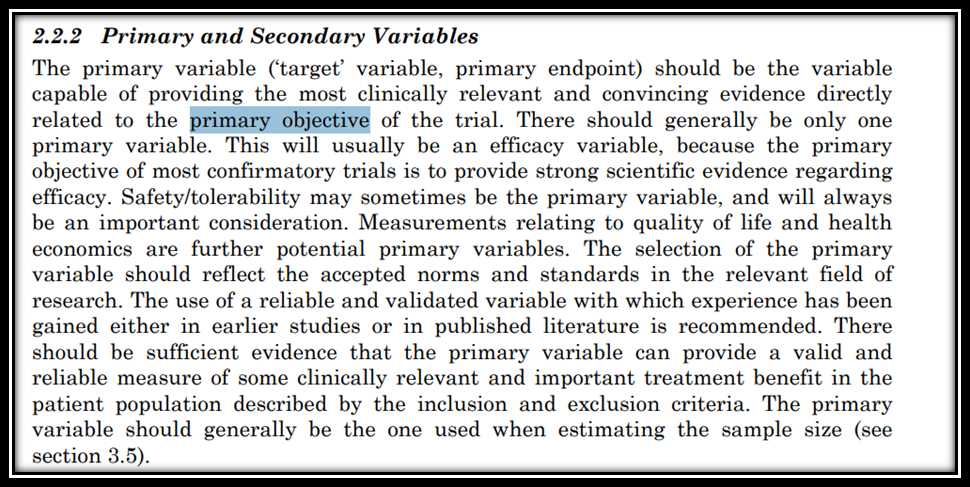
Well, a concise answer would be to solve the primary study question as accurately as possible.
If the patient size is lacking, there could be a chance that the efficacy of an IP may be overlooked. The clinical trial in itself could end up being futile, and the patients could be exposed to unnecessary risk without prospects of any treatment. On the other hand, an over-recruitment would be financially draining for the sponsor. Not only that, patients recruited in the later stages of the study, those that joined after significant progress has already been made, might end up participating for no justified reason.
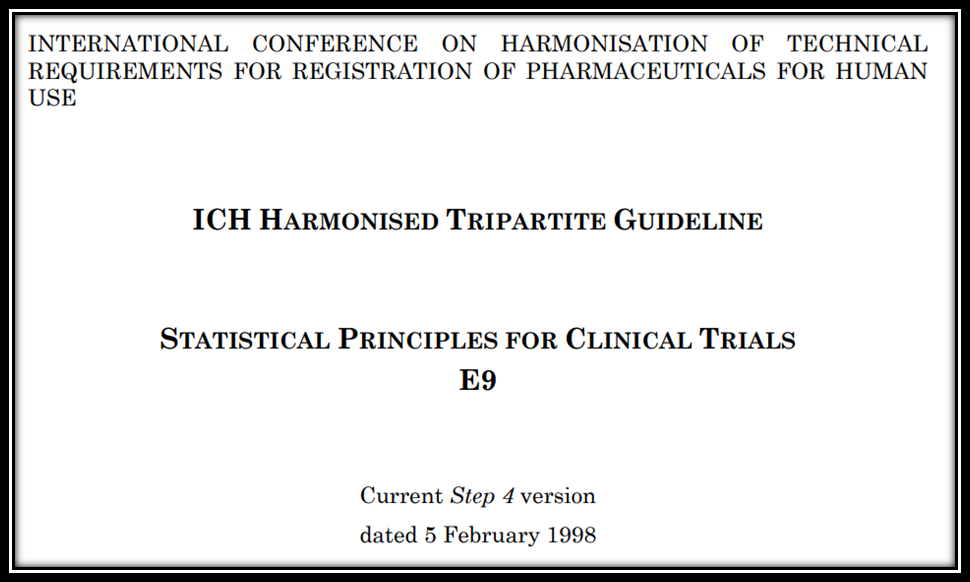
According to ICH-GCP E9, the sample size calculation and justifications are as follows
What factors must be considered in calculating a sample size?
Three factors must be considered into the calculation
- The data from recruitment needs to yield clinically meaningful differences, while also maintaining statistical power.
- If a shortage of funds and other medical considerations hinder recruitment, what could the rather ‘best bang for the buck’ sample size make up for compromised statistical power.
- With the overarching primary study objective in mind, what type of primary endpoint/outcome variable (eg. continuous, categorical, binary outcomes) would be suitable
What are the components of the calculation?
- H0 = null hypothesis, used often to ‘control’ Randomized placebo/active CONTROLED clinical trial by acting as the standard when a conjecture begins with ‘null hypothesis is true’.
- H1 = the alternative hypothesis, used often to represent statistical power of IP made through sponsor R&D.
| Reject H0 | Hypothesis | Accept H0 | ||
| H0 True H1 | Type 1 error (α) | 1- α | ||
| 1- β | Type 2 error (β) | |||
- Type 1 error = Statistical power of IP is lacking, but got approved “RED FLAG” by regulatory agencies
- Type 2 error= Statistical power of IP is adequate, but was flagged by the agency.
- Effect size = Minimum Clinically Important Difference(MCID) (δ)
- Standard deviation or Variance (σ)
- Continuous Endpoint (eg. quality of life, tumour size)
- Binary Endpoints (eg, yes/no, reaction rate)
- Duration of incident (eg. Survival period)
- Z-score = Answering within the bell-curve, how many steps far out from the center
- Bonferroni Correction αcorrected = α/m
- Discordance rate = proportion of pairs expected to yield conflicting results.
- Comparing a condition from two independent group over time?
Situation: Consider a scenario from clinical trial design where a new dietary intervention is tested against a control group. The researchers expect the diet to lower cholesterol by a true difference (δ) of $10mg/dL. Historical data tells them the standard deviation (σ) is 50 mg/dL
→ Cholesterol levels can be subject to large variability (σ) = 50 depending on any given situation. If the expected difference is relatively low δ = 10, then there needs to be a tremendous sample size to justify true therapeutic effect from the crowd. Solving for
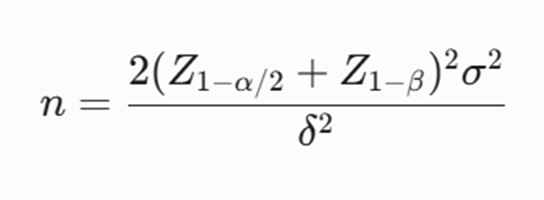
we can calculate that n = 525, so two groups would require a total of 1050 participants.

2. Comparing pre-treatment, post-treatment as primary objective?
Lets consider a scenario where a clinical trial measures the pre-treatment and post-treatment of patients to measure the effectiveness of an intervention.
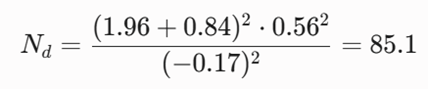
Situation: A clinical trial is conducted to compare the serum cholesterol levels before, and after an exercise program. Difference (δ)in pre- and post- workout cholesterol primary endpoints is -0.17, and a dissertation stipulating the standard deviation (σ) as 0.56 is to be cited. How many pairs are needed to yield a type 1 error of 5% (α) and a power (1-β) of 80%
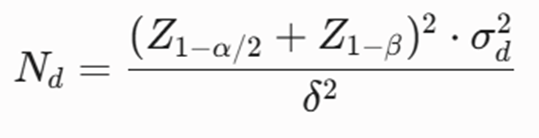
→ Compared to a parallel trial design, a paired continuous test tracking the exact same individual is much more efficient and cost effective. When the expected average drop in cholesterol per person is -0.17 (δ), and the variability of change within individuals is 0.56 (σ)
3. Answering a yes/no question of improvement in prognosis within two independent groups?
Situation: A research team at the ECOG (Eastern Cooperative Oncology Group), a central research institution in the United States, conducted a randomized clinical trial evaluating chemotherapy treatments for malignant lymphoma. Four types of combination regimens were utilized in this study: BCVP, COPA, COPB, and CPOB.
The primary objective of this experiment was to determine whether the COPA, COPB, and CPOB regimens demonstrate a higher therapeutic response (complete clearance of lymphoma) compared to BCVP, which had been the established standard treatment.
Based on historical data and past research experience, it is considered realistic to expect a 30% therapeutic response rate with BCVP, whereas the other three experimental treatments are anticipated to achieve a 50% response rate.What sample size is required for this clinical trial to maintain a 5%Type I error rate and 80% statistical power?
Since, BCVP was the standard treatment and is the control group for the comparison with the other three
Control Group Success rate PC = 30% (0.30)
Intervention Group Success rate PI = 50% (0.5)
Baseline average = (0.30 + 0.50)/2 = 0.40
1-β = 80%, equivalent to Z1-β = 0.84
α = 5%, (0.05)
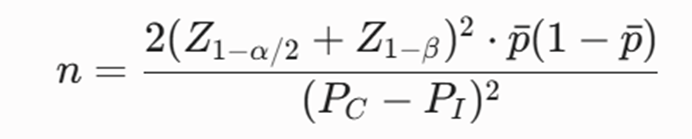
→ Since this is a multi-arm trial design, we are effectively comparing three new treatments to a single control group. A Bonferroni Correction must be applied

A Z-score for 0.01667 is 2.394 and therefore the correct subjects per arm is
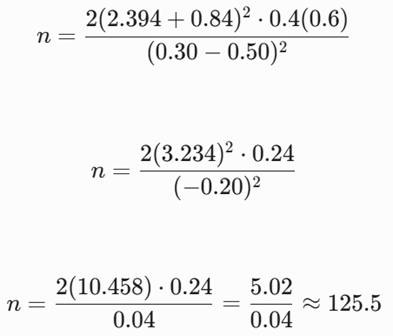
So a total of 126 * 4 = 504 particpants are needed to keep the study within 95 percent confidence interval, and 80% statistical power.
4. When dealing with a paired binary outcome?
In a clinical trial for vision treatment, one eye of each subject is to be randomly assigned to laser treatment, and the other eye to standard treatment. Let PI be the proportion of eyes retaining vision in the laser treatment group, with a success rate of 0.4. Let PC be the proportion of eyes retaining vision in the standard treatment group, with a success rate of 0.2.
If the discordance rate (f) of the treatment outcomes between the two eyes is 0.8, how many paired samples (number of pairs) are required for this clinical trial to achieve a significance level of 0.05 and a statistical power of 90%?
Expected laser success rate (PI) = 0.4
Expected standard success rate (PC) = 0.2
Expected difference (d) = 0.4-0.2 = 0.2
Expected discordance rate(f) = 0.8
Targeting a 5% significance level (α = 0.05) and 90% statistical power (1- β) = 0.90
→ Since this is paired (pre-, post- comparison within same individuals) with binary outcomes(fail, success, etc), it is easy to expect for enhanced primary endpoints. However, we must also account for discordance. One treatment might actually fail, therefore it is pertinent that we take that into consideration.
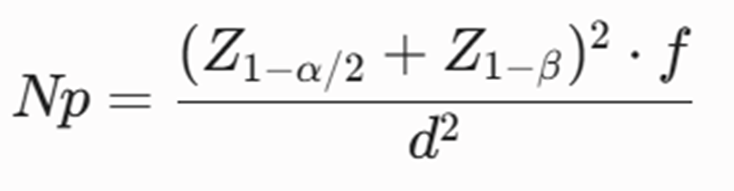
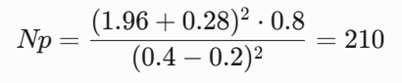
Final patient recruitment needs to be 210.
(recruitment for equivalence studies, non-inferiority, and sample size adjustments
to be continued…)