When conducting medical device clinical trials, navigating the dual challenges of skyrocketing costs and prolonged timelines is a common hurdle. Left unmanaged, budget overruns and milestone delays severely damage not only your development momentum but also your industry credibility. 🤦♂️
How can you maintain the strict quality of a clinical trial while successfully balancing both budget and time? Today, we distill essential, field-proven expertise—spanning protocol simplification, cost forecasting optimization, and Risk-Based Monitoring (RBM)—into an actionable guide you can immediately deploy in your operations! 👇
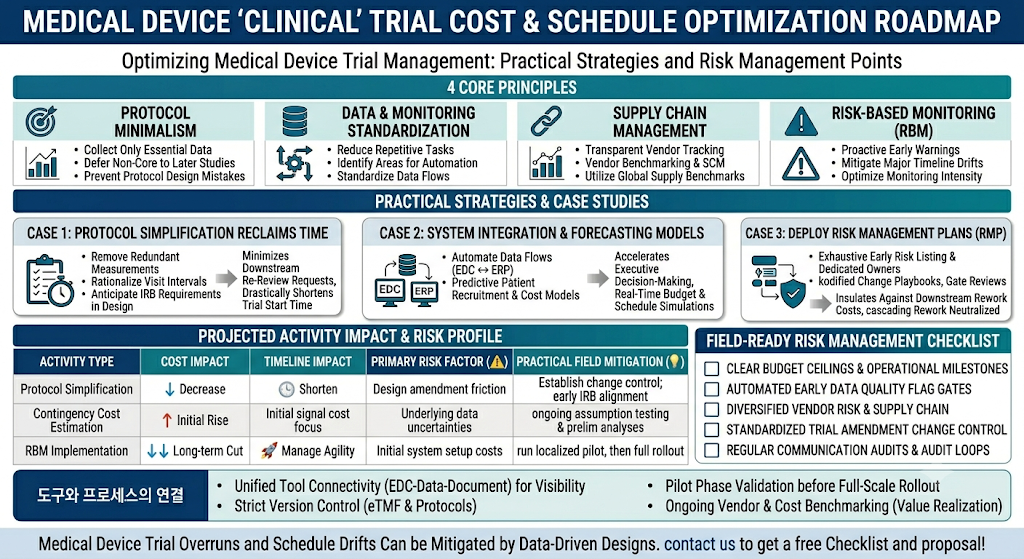
🎯 1. Four Core Principles of Cost & Schedule Management
An overly complex clinical trial design is a primary driver of budget inflation. Use these four foundational principles to slim down your operational processes:
- Protocol Minimalism: Design the protocol to collect only the bare minimum of essential variables required for your primary endpoints. Defer non-core data collection to follow-up or post-market studies.
- Standardization & Automation: Standardize data management and monitoring procedures to minimize repetitive manual field tasks and actively isolate processes ripe for automation.
- Transparent Vendor Tracking: Leverage supply chain management (SCM) benchmarks and data tracking to keep third-party vendor and outsourcing costs completely transparent.
- Proactive Mitigation via RBM: Implement Risk-Based Monitoring (RBM) to identify early warning signs and resolve field anomalies before they escalate into major timeline drifts.
🔍 2. Field-Tested Action Strategies: Real-World Case Studies
Theoretical frameworks are valuable, but execution blueprints from the field offer the definitive answers. See how top-performing teams bypassed critical operational risks:
📱 Case Study A: Streamlining Protocols to Reclaim Lost Time
- The Strategy: The team preserved the absolute essence of the defined research goals while aggressively removing redundant measurement items and optimizing the intervals between patient site visits. Additionally, they structured the design to proactively anticipate Institutional Review Board (IRB) requirements.
- The Result: This minimized downstream re-review requests and protocol corrections, drastically shortening the time required to secure formal approvals and open trial sites.
🗄️ Case Study B: System Integration & Forecasting Models to Eradicate Cost Variances
- The Strategy: By linking the Electronic Data Capture (EDC) platform directly with the Enteprise Resource Planning (ERP) architecture, the team automated data flows. They deployed predictive data models to project patient recruitment timelines and per-patient costs across multiple operational scenarios.
- The Result: Any field adjustments were immediately simulated to reflect live impacts on cost and schedule, allowing the executive team to make high-velocity decisions.
🛡️ Case Study C: Deploying Risk Management Plans (RMP) to Insulate Execution
- The Strategy: Potential risks were exhaustively listed during the initial kickoff phase, with specific mitigation playbooks and dedicated risk owners assigned to each item. Essential trial changes were swiftly codified back into the protocol, and critical risk flags were managed via multi-stage Gate Reviews.
- The Result: The team completely neutralized the cascading rework expenses and operational delays caused by unexpected study amendments.
📊 Projected Activity Impact & Risk Profiles At a Glance
| Action Type | Cost Impact | Timeline Impact | ⚠️ Primary Risk Factor | 💡 Practical Field Mitigation |
| Protocol Simplification | Potential Decrease | Potential Shortening | Design amendment friction | Establish change control; conduct early IRB alignment |
| Contingency Cost Estimation | Initial stabilization costs may rise | Increased setup phase signals | Underlying data data uncertainties | Execute ongoing assumption testing & preliminary analyses |
| RBM Implementation | Long-term cost reduction | Improved management agility | Initial system setup and rollout costs | Run a localized pilot phase before full-scale trial deployment |
📋 [Field Ready] Risk Management & Operational Checklist
Ensure your medical device trial has verified each of these critical checkpoints before advancing to the next milestone:
- [ ] Milestone Specificity: Are clear budget ceilings and operational milestone timelines locked in and signed off?
- [ ] Automated Data Quality: Have automated checking logic gates been introduced to flag data quality issues at the exact moment of initial entry?
- [ ] Supply Chain Diversification: Is vendor risk distributed across a diversified pool of suppliers to prevent single-source operational bottlenecks?
- [ ] Standardized Change Control: Is there a standardized protocol amendment workflow to compress the cost of re-executing altered trial segments?
- [ ] Communication Loops: Are communication networks between the sponsor, CRO, and clinical sites audited regularly to prevent information silos?
💡 Editor’s Tip: Seamless Tool Connectivity Equals Ultimate Agility! Establish complete data visibility by fusing your EDC, data management protocols, and document repositories into a unified workflow. Maintain strict version control across your eTMF and study protocols. Validate your RBM workflows in a localized pilot phase first; once proven, expand it across all active trial centers to minimize upfront structural risks.
🚀 Shifting to Execution: Your Next Steps (CTA)
Systematically managing medical device trial workflows using data-driven principles is the absolute best way to insulate your project from budget overruns and schedule slippage. Upgrade your clinical roadmap this week:
- Isolate Simplified Variables: Audit your current active protocol design to see if there are non-essential variables or redundant secondary metrics you can safely trim.
- Draft an RBM Pilot: Map out a lightweight Risk-Based Monitoring plan restricted to a small cohort or a single site to evaluate its compatibility with your team’s routine.
- Claim Your Master Templates: If you are actively navigating cost forecasting inaccuracies or timeline friction, don’t face it alone. Leave a comment or drop an inquiry below—we will send over a complimentary clinical checklist and custom strategy template tailored to your pipeline!
#MedicalDevice #ClinicalTrials #CostEfficiency #ScheduleManagement #RiskManagement #ClinicalProtocol #RBM #ClinicalOperations #CRAs #MedTech #ClinicalData