Leading a medical device clinical trial often brings moments of high stress. 🤦♂️ Unexpected timeline delays, compromised data quality, and rapidly escalating budgets can severely jeopardize your entire project.
How can we eliminate these uncertainties and maximize our probability of success? Today, we share a comprehensive guide on “Structured Risk Management Frameworks,” “Criteria for Selecting Failing-Proof Multi-Center Partners,” and “Flawless KPI Setup Guidelines” straight from the field. Read on to transform your operations! 👇
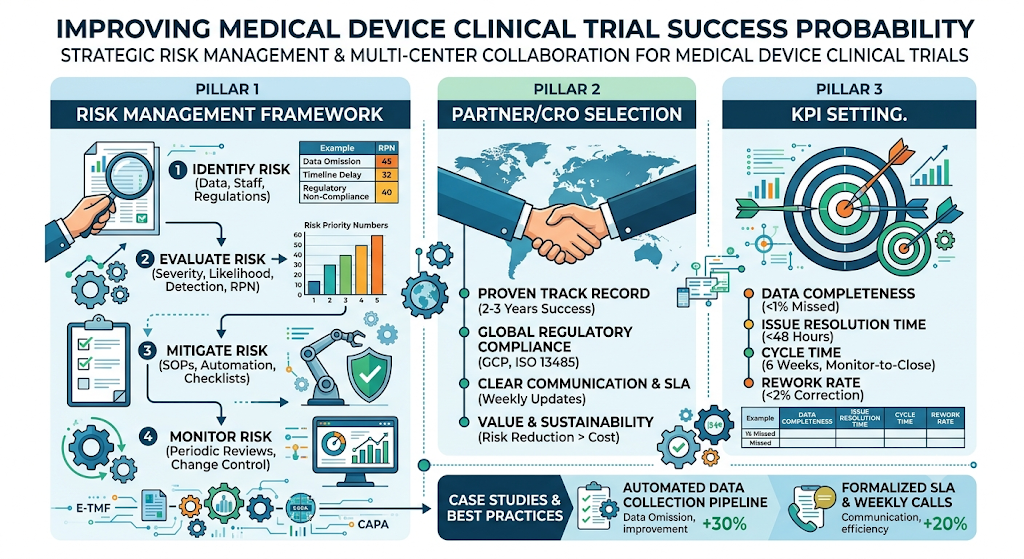
🎯 1. The Core Risk Management Framework
Proactively preventing predictable risks can save massive amounts of time and capital. Keep these 4 core pillars of risk management in mind:
- Identify: Map out all potential risks during the initial design phase, categorizing them into data management, staffing/personnel, and regulatory compliance.
- Evaluate: Quantify the severity, likelihood, and detection capability of each risk to prioritize them (e.g., utilizing Risk Priority Numbers – RPN).
- Mitigate: Establish defensive barriers such as strengthening Standard Operating Procedures (SOPs), automating data quality checks, and reinforcing monitoring routines.
- Monitor: Implement periodic reviews and a strict change control process to update risk statuses in real time.
💡 [Field Tip] Example Risk Priority Number (RPN) Evaluation Guide
| Risk Item | Severity | Likelihood | Detection | ✨ Priority (RPN) |
| Data Omission | 5 | 3 | 3 | 45 (Top Priority) |
| Regulatory Non-Compliance | 5 | 2 | 4 | 40 |
| Timeline Delay | 4 | 4 | 2 | 32 |
🤝 2. Selection Criteria for Multi-Center Partners (CROs/Sites)
Choosing the wrong partner can destabilize both the quality and velocity of your study. Instead of looking solely at the price tag, you must rigorously balance track records, credibility, and communication agility.
- RFI/Proposal Micro-Inspection: Thoroughly check the specificity of the partner’s quality management systems, data processing capabilities, and regulatory compliance frameworks.
- Verify Recent Track Record: Review successful study case studies and emergency troubleshooting capabilities for identical or similar device types over the last 2 to 3 years.
- Global Regulatory Compliance: Ensure they meet foundational GCP/GLP mandates and maintain international standard certifications like ISO 13485.
- Communication and SLA Clarity: Explicitly define update cadences, issue resolution cycles, and decision-making workflows within the Service Level Agreement (SLA) right from the contract phase.
📋 Core Partner Evaluation Checklist
| Evaluation Item | Detailed Criteria | 🔍 Practical Checkpoints |
| Quality System | ISO 13485 certification status, CAPA framework | Double-check the 3-year recertification status! |
| Regulatory Compliance | Adherence to GCP/GLP and data security standards | Audit historical inspection and finding logs. |
| Track Record | Number of successful identical/similar device trials | Focus heavily on data from the last 2 years. |
| Communication | Weekly update loops, emergency response times | Ensure a direct hotline and clear contact windows. |
| Cost & SLA | Quality vs. unit price, timeline penalty clauses | Specifying explicit SLA metrics is mandatory. |
📈 3. Actionable KPI Setting Guidelines
To drive high performance, abandon vague milestones and lock in “measurable KPIs.” Apply the SMART principle to balance data integrity, speed, and responsiveness.
💡 Recommended Measurement Tools: Electronic Trial Master File (e-TMF), CAPA tracking software, and monitoring logs.
| Core KPI | Definition / Metric | 🎯 Target Metric | Measurement Cadence |
| Data Completeness | Ratio of missing data points in final reports | < 1% | Weekly |
| Rework Rate | Ratio of initial data entry corrections | < 2% | Monthly |
| Issue Resolution Time | Average duration from intake to formal closure | Within 48 hours | Monthly |
| Cycle Time | Average period from site monitoring to close-out | Within 6 weeks | Quarterly |
🔍 Real-World Case Studies: Lessons from the Field
- 📱 Case Study A (Resolving Data Omission): During a multi-center study, recurring data omissions were identified at a specific hospital site. The team immediately introduced an automated data collection pipeline alongside standardized intake forms, which drastically eliminated missing variables.
- 🤝 Case Study B (Overcoming Timeline Drifts via Communication): A project suffered from prolonged site-monitoring cycles due to delayed responses among stakeholders. By formalizing weekly sync calls and stipulating explicit SLA penalty clauses, the team cut down field issue resolution times by over 50%.
🚀 Next Steps for Practical Action (CTA)
The golden rule for medical device trial success boils down to “airtight risk management” and “transparent collaboration with verified partners.” Upgrade your team’s operational processes this week!
- Step 1. Share this risk management framework and partner checklist with your core team to uncover any hidden vulnerability gaps in your active pipeline.
- Step 2. If you are approaching a new CRO contract or an institutional review, draft a KPI template (focusing on data completeness and response times) to align goals beforehand.
If you have any questions about clinical protocol optimization, partner matching, or need custom templates, feel free to leave a comment below! We will see you in the next post with more data-driven operational insights. 😊
#MedicalDevice #ClinicalTrials #RiskManagement #PartnerSelection #MultiCenterTrial #ClinicalKPIs #ClinicalOperations #CRAs #MedTech #ClinicalDesign