The very first step that determines the success or failure of a clinical trial is the Protocol. The protocol serves as an absolute standard, dictating not only the direction of the study but also what is required to pass the stringent review of regulatory agencies.
In practice, however, vague objectives and ambiguous criteria often delay study timelines and compromise data quality.
Today, we will break down the Clinical Trial Protocol Development Strategy into step-by-step checklists, practical tips, and risk management points that both beginners and seasoned professionals can easily apply.
🎯 Core Points of Protocol Development Strategy
To design a robust protocol, you must first establish a solid overall workflow and focus on enhancing the intrinsic quality of the document.
1. Step-by-Step Workflow for a Successful Protocol
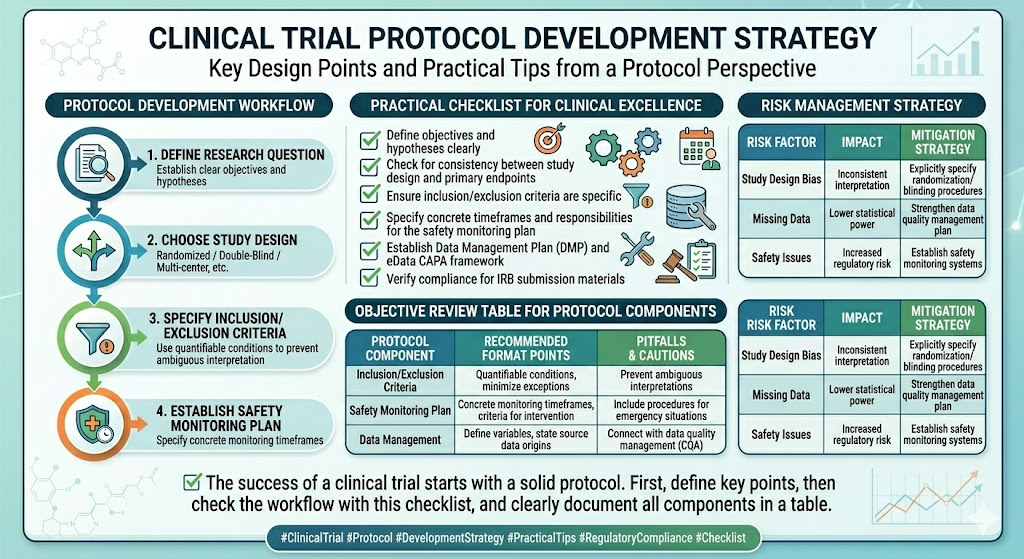
Define Research Question ➡️ Select Study Design (Randomization / Double-Blind / Multicenter, etc.) ➡️ Specify Inclusion/Exclusion Criteria ➡️ Establish Safety Monitoring Plan
2. Fundamental Rules for High-Quality Documentation
- Clarify Purpose: Clearly state the underlying rationale and objective for each section.
- Simplify Terminology: Thoroughly eliminate ambiguous terms that leave room for misinterpretation.
- Streamline Data: Limit data collection points to the “absolute minimum” required for analysis to reduce site fatigue.
💡 Good & Bad Cases in Practice
- 🚨 Bad Case (Flawed Inclusion Criteria): Setting overly broad inclusion criteria to ease patient recruitment can backfire, causing unexpected safety issues or rendering data interpretation impossible later on.
- ✨ Good Case (Concrete Safety Monitoring): Clearly defining the timing and procedures for safety monitoring within the protocol speeds up regulatory approvals (e.g., FDA, MFDS) and ensures smoother operational execution on-site.
📋 Practical Checklist for Clinical Excellence
To prevent oversight during the initial design phase, make sure to cross-check these 6 critical items:
- [ ] Objective & Hypothesis Clarity: Is the core question this trial aims to prove clearly stated?
- [ ] Consistency Check: Do the study design and primary endpoints align seamlessly with each other?
- [ ] Criteria Specificity: Are the Inclusion/Exclusion criteria measurable and objective?
- [ ] Safety Planning: Are the exact timing and personnel responsible for safety monitoring explicitly named?
- [ ] Data Management: Is a solid Data Management Plan (DMP) and an electronic data CAPA (Corrective and Preventive Action) framework established?
- [ ] Regulatory Compliance: Does the documentation for IRB/IEC submission comply with the most up-to-date regulations?
🔍 Objective Review Table for Protocol Components
| Protocol Component | Recommended Format & Core Points | Practical Tips & Pitfalls |
| Inclusion/Exclusion Criteria | • Present quantifiable conditions • Minimize exception clauses | Eliminate vague language to prevent inconsistent interpretation across clinical sites. |
| Safety Monitoring Plan | • Specify exact monitoring timelines • Establish clear intervention thresholds | Ensure emergency procedures and reporting hierarchies are included for urgent situations. |
| Data Management | • Define variables clearly • Note the source data origins | Ensure a seamless link with the Clinical Quality Assurance (CQA) system. |
⚡ Risk Management and Practical Application
Even the most flawless protocol will face unexpected hurdles in the real world. Anticipating potential risks and preparing mitigation strategies in advance is what sets an expert researcher apart.
🛠️ Risk Mitigation Strategy Matrix
| Risk Factor | Impact on Clinical Trial | Mitigation Strategy |
| Study Design Bias | Inconsistent data interpretation and lowered credibility | Explicitly detail randomization and blinding procedures within the protocol. |
| Missing Data | Failure to secure statistical significance and lower reliability | Strengthen the data quality management plan and provide pre-trial training on EDC (Electronic Data Capture) entry guides. |
| Safety Issues | Trial suspension and increased regulatory risks | Activate a robust safety monitoring framework (e.g., DSMB) and finalize specific intervention plans early on. |
🚀 Conclusion & Action Plan
Ultimately, the key to a successful clinical trial lies in securing a triad of “Clarity in Design,” “Subject Safety,” and “Data Quality.”
Gather your team today, open up this core checklist, and double-check whether your protocol’s inclusion/exclusion criteria or safety plans have any loopholes. If you are dealing with a large-scale trial where risks are high, conducting a small pilot test beforehand is an excellent practical tip to detect and fix flaws early.
A rock-solid protocol is the shortest path to accelerating successful drug and medical device development.
Tags: #ClinicalTrial #ClinicalProtocol #DevelopmentStrategy #PracticalTips #RegulatoryCompliance #Checklist