While conducting clinical trials, unexpected issues frequently arise, often leading to project timeline delays and a decline in data quality.
This post serves as a practical guide for clinical trial issue resolution. We will explore a systematic 4-step process—from defining the problem to identifying the root cause, executing solutions, and preventing recurrence—along with essential regulatory compliance checkpoints to help you clear roadblocks swiftly and confidently!
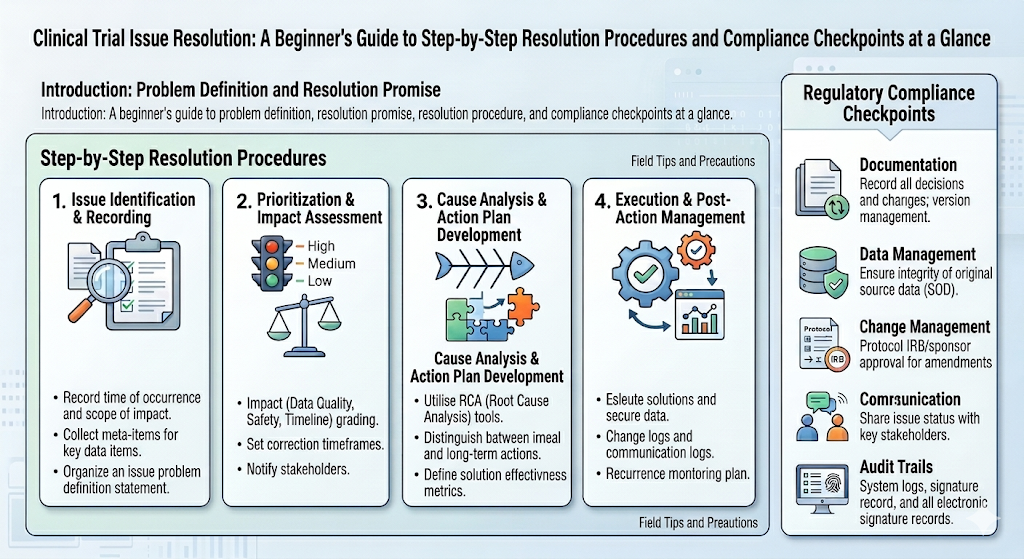
🛠️ The 4-Step Issue Resolution Process
By following this structured 4-step framework, you can handle unexpected problems consistently while maintaining a flawless, audit-ready paper trail.
Step 1. Issue Identification & Documentation
- Assess the Impact Scope: Document the exact time the issue occurred and determine its immediate scope of impact.
- Gather Metadata: Meticulously collect related metadata and critical data points associated with the issue.
- Draft a Problem Statement: Synthesize the core problem into a clear, one-line problem statement that any stakeholder can easily understand.
Step 2. Prioritization & Impact Assessment
- Assign Severity Ratings: Classify the issue by severity based on its potential impact on data quality, participant safety, and the overall project timeline.
- Set Remediation Deadlines: Establish a clear target deadline for resolution and immediately notify all relevant stakeholders.
Step 3. Root Cause Analysis & Action Plan
- Analyze the Root Cause: Use Root Cause Analysis (RCA) tools to look past surface-level symptoms and uncover the true underlying issue.
- Differentiate Actions: Develop a two-pronged action plan consisting of immediate ‘short-term containment measures’ and systematic ‘long-term corrective actions’.
- Define Success Metrics: Establish concrete key performance indicators (KPIs) to measure whether your solution effectively resolves the issue.
Step 4. Execution & Post-Resolution Care
- Secure Verification Data: Execute the defined solution and gather objective data to verify that the issue has been fully resolved.
- Maintain Logs: Document the entire process in a Change Log and keep detailed communication logs of all collaborative efforts.
- Prevent Recurrence: Formulate a long-term monitoring plan and integrate it into your quality management workflow to ensure the problem does not happen again.
📋 Regulatory Compliance Checkpoints to Remember
Clinical trials are deeply rooted in regulatory science. Even when rushing to fix an emergency, the following compliance requirements must always be prioritized:
* Documentation: Record every single decision and modification in detail, and maintain strict version control. * Data Integrity: Cross-verify all resolutions against the original Source Documents (SOD) to guarantee absolute data integrity. * Change Management: If the resolution requires a modification to the protocol or safety plans, ensure it goes through formal IRB/IEC review and approval. * Transparent Communication: Keep primary stakeholders and regulatory bodies informed with transparent, timely updates on the status of the issue. * Audit Trail: Ensure all user actions, system logs, investigator signatures, and pre-electronic signature records are securely preserved.
📊 Real-World Scenarios & Application Matrix
Here are 3 common field examples showing how this systematic process applies to real-world clinical trial challenges.
| Scenario | Issue Type | Resolution Process Summary | Compliance Keypoints |
| Data missing due to a missed subject visit | Data Quality Issue | 1) Identify missing data 2) Assess timeline impact 3) Analyze root cause 4) Execute alternative visit plan | Cross-check SOD, document in the log, and review if an IRB update is required. |
| Protocol deviation/violation discovered | Compliance Issue | 1) Report immediately 2) Evaluate deviation scope 3) Establish preventive actions 4) Implement change management | Maintain exact change logs, and follow official IRB/Regulatory body reporting protocols. |
| Subject schedule delays due to an eCOA/IWRS system error | Operations Issue | 1) Deploy communication plan 2) Reschedule visits 3) Re-validate data impact 4) Conduct post-monitoring | Document communication logs, and verify data integrity once the system normalizes. |
💡 Quick Tips from the Field
- Build a preliminary checklist today. When an unexpected issue hits, panic can cloud your judgment. Having a simple, pre-formatted log sheet ready for immediate tracking is the best way to mitigate risk.
- Cross-functional communication is everything. Don’t try to solve complex protocol issues in a silo. Bringing in cross-functional teams (CROs, Data Managers, Biostatisticians) early always leads to faster, more robust solutions.
- Make the “Audit Trail Mindset” a daily habit. During regulatory inspections, auditors look at why a certain decision was made. Always document the background rationale behind your corrective actions.
🎯 Conclusion & Call to Action (CTA)
The core pillars of clinical trial issue resolution are “swift response” and “impeccable documentation”. If you want to elevate your team’s compliance and operational speed, try implementing a dedicated “Weekly Issue Log” starting this week.
Tags: #ClinicalTrials #StepByStep #Compliance #Guide #FieldTips