When conducting clinical trials or post-market pharmacovigilance, one of the most tense moments is when a SUSAR (Suspected Unexpected Serious Adverse Reaction) occurs.
Accurately judging the moment a risk signal is captured and responding consistently according to the designated reporting cycle and communication route is not only directly related to patient safety but also the core of preparing for regulatory agency audits. However, it is often difficult to apply in practice between the global regulations that set international standards and the domestic guides that provide detailed guidelines tailored to the field situation.
In today’s post, we will summarize the key differences between the two systems and meticulously go over the application points and checklists that can be utilized immediately in the field.
🌐 What are the differences between Global Regulations and Domestic Guides?
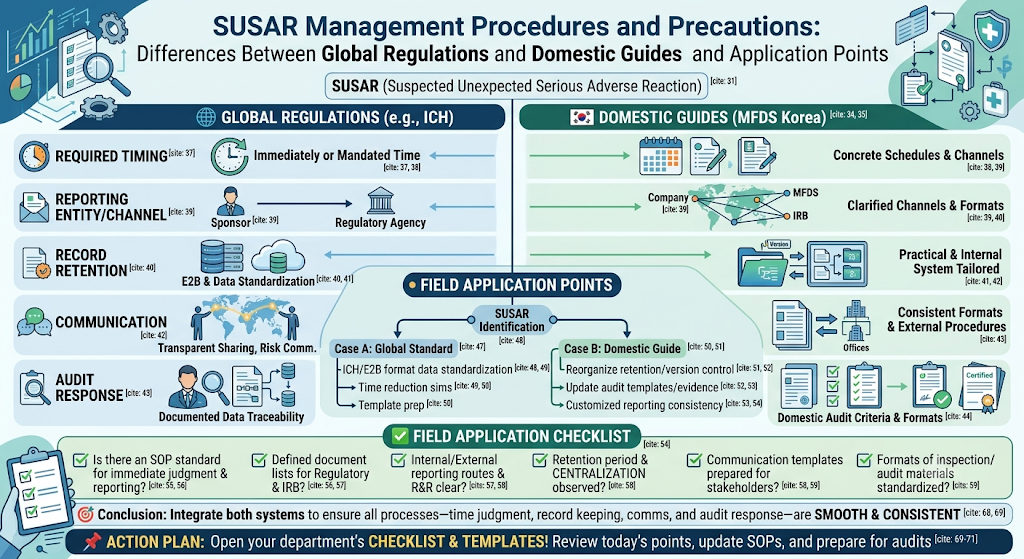
Global regulations (like ICH guidelines) and domestic MFDS (Ministry of Food and Drug Safety) guides are generally on the same track but show differences in detailed execution methods. We have briefly compared the key points in the table below.
| Category | Points of Global Regulations | Points of Domestic Guides | |
| Required Timing | Recommends reporting immediately or at the regulatory mandated time when a SUSAR is identified/confirmed. | Specifies concrete schedules and channels tailored to the domestic situation, concretizing the scope of field application. | |
| Reporting Entity/Channel | The Sponsor leads the official reporting to the regulatory agency. | Reporting channels and formats between the domestic competent authority and the internal responsible person in the company are clarified. | |
| Record Retention | Emphasizes data standardization and the establishment of electronic record systems (e.g., E2B). | Practical record retention methods tailored to internal systems and processes. | |
| Communication | Requires transparent sharing of safety information and a risk communication system. | Ensures consistency in reporting formats and external communication procedures according to domestic regulations. | |
| Audit Response | Traceability of documented data and audit response capabilities are important. | Standardization of templates and forms of evidence tailored to domestic audit standards. |
💡 Practical Tip: The core lies in ‘consistency in judging the reporting time’, ‘standardization of records’, and ‘utilization of communication templates’. Understanding this difference allows you to implement complex SUSAR management procedures into a single, seamless process.
💡 Practical Field Application Points and Actual Cases
So, how should this be applied in actual work? We have organized case-by-case application points that can be used immediately in the field.
Case A: Global Standard Application Guide
This is the case where global standards must be strictly followed, such as in multinational clinical trials.
- Process: SUSAR Identification ➔ Immediate Reconfirmation ➔ Data standardization tailored to ICH/E2B(R2, R3) formats ➔ Routing to the electronic reporting system.
- Time Reduction: Clarify the division of roles of the reporting entity, and build a regular simulation workflow to reduce the actual reporting time.
- Prior Preparation: Prepare communication templates in advance, such as English notices and global update emails.
Case B: Domestic Guide Tailored Reinforcement Guide
This is the case where thorough preparation for domestic regulatory requirements and inspections is necessary.
- Document Management: Reorganize the record retention period and document version control system in accordance with domestic regulations (e.g., KGCP).
- Audit Preparation: Update domestic audit response templates and evidence lists, and standardize the internal approval and sign-off flow.
- Customized Reporting: Strengthen consistency with customized formats according to reporting channels to the MFDS and IRB.
✅ Easy-to-Miss Field Application Checklist
If you are a practitioner, this is an essential checklist to keep in front of your desk.
- [ ] Is there a standard (SOP) to immediately judge and determine whether to report upon identifying a SUSAR?
- [ ] Is the list of documents required for reporting to regulatory agencies and the IRB defined in advance?
- [ ] Are the internal/external reporting routes and the R&R of the person in charge clear?
- [ ] Is the retention period for related records observed, and are the documents centralized (Centralization)?
- [ ] Are communication templates prepared for communicating with stakeholders (investigators, sponsors, etc.)?
- [ ] Are the formats of materials for responding to inspections/audits standardized?
📋 At-a-Glance Summary Comparison Table for the Field
We have intuitively organized the items that are most often confusing in the field. Please refer to this when creating a work manual.
| Item | Global Points | Domestic Points | Practical Field Application Points (Action Item) | |
| Reporting Time | Report immediately upon discovery/confirmation. | Comply with domestic regulation schedules. | Guide with a checklist for immediate judgment upon identification. | |
| Reporting Channel | Official reporting to regulatory agencies. | Comply with domestic designated channels/formats. | Manualize reporting routes by person in charge/institution. | |
| Record Retention | Data standardization/electronification. | Version control customized to internal systems. | Introduce a central repository (e.g., TMF) and access rights management. | |
| Communication | Transparent sharing of safety information. | Communication tailored to domestic reporting formats. | Equip templated notices and update processes. | |
| Audit Response | Traceability of evidence. | Materials tailored to domestic inspection standards. | Share audit response checklists and formats internally. |
🎯 Conclusion: Check it right now!
In SUSAR management, global regulations emphasize international standards and data formats for reporting, while domestic guides provide specific and practical procedures for field application. Clearly understanding and integrating the differences between the two systems allows for all processes, including reporting time judgment, record management, communication, and audit response, to proceed much more smoothly and consistently.
📌 Action Plan: Open your department’s SUSAR management process checklist and templates right now. We recommend conducting a field workshop or reorganizing the SOP based on the checklist we examined today.
If you need help, please leave a comment or contact us anytime. We will think together about a customized guide that fits your field situation! 😊
🏷️ Tags: #SUSAR #GlobalRegulations #DomesticGuides #ClinicalTrials #Pharmacovigilance #Differences #FieldApplication #PV #AuditResponse